




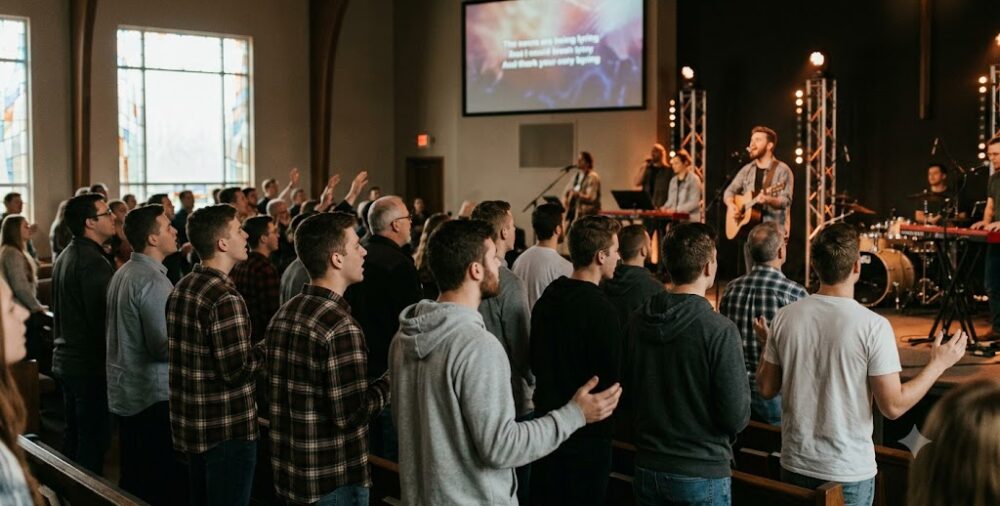

For twenty-five years, one of the most reliable facts in American religious life was this: women showed up more than men. More often in the pews, more often in the Bible studies, more often in the prayer groups. Sociologists treated the gender gap in church attendance the way meteorologists treat the tides — a constant you could build models on.
In 2025, the tide reversed.
Barna’s research found men reporting higher church attendance than women — the first time in a quarter century the line has flipped. And the reversal is being driven from the bottom of the age chart, not the top: Gen Z men are now attending slightly more often than Millennial men, who are themselves attending more than their parents. Young men — the demographic every congregation had quietly written off — are outpacing young women in Scripture engagement, and their stated commitment to Jesus has jumped roughly fifteen percentage points since 2019. Barna’s own researchers called the findings unexpected, which is polite research-speak for we did not see this coming.
The pattern isn’t only American. In the UK, Bible Society research found church attendance among 18-to-24-year-olds has quadrupled since 2018 — from 4% to 16% — a shift large enough that British observers have started calling it the Quiet Revival. Bible sales in Britain hit an all-time high last year.
Something is happening. The honest part — the part that makes this worth writing about rather than merely celebrating — is that nobody can fully explain what.
The candidate explanations
When a trend surprises everyone, explanations rush in to fill the vacuum, and most of them tell you more about the explainer than the trend. So here are the leading theories, each stated as fairly as we can manage — because the truth is probably some braid of all of them.
Theory one: the loneliness cure. Young men are, by nearly every measure, the most isolated demographic in modern America. They report fewer close friendships than any generation of men before them, they date less, they join less, and they spend more of their lives mediated through screens. A church is one of the last institutions in American life that will simply take you — no application, no algorithm, no swiping, no fee at the door — and place you in a room of people across every age who expect to see you again next week. If you were designing a treatment for the male friendship recession from scratch, it would look suspiciously like a congregation.
Theory two: algorithm fatigue. A seminary professor watching the trend put it bluntly: young men are fed up with a virtual world run by algorithms and dating apps, and they are seeking something real. There’s something almost poetic in the possibility that the most digitally native generation in history is walking into the least digital institution it can find — a room with wooden pews, a person speaking without a screen, bread and wine, silence. The generation raised on infinite content may be the first to feel, in its bones, that infinite content is a diet of air.
Theory three: the hunger for demand. For decades, the prevailing wisdom held that churches keep young people by asking less of them — softer messages, shorter services, lower bars. The current wave suggests the opposite. Anecdotally and in early data, young men are disproportionately drawn to the most demanding expressions of faith: liturgical traditions, fasting calendars, confession, early-morning prayer. An entire online cottage industry of secular male self-improvement — cold plunges, discipline regimens, rules for life — spent a decade proving that young men will submit to hard structures if the structure promises meaning. The traditions have been offering that deal for two thousand years. Some young men appear to have noticed.
Theory four: the political sorting. The least comfortable explanation, and it can’t be waved away. Young men and young women are politically diverging faster than any generation on record — men drifting right, women drifting left — and religious attendance in America correlates with that divide. Under this theory, some portion of the male return to church is less a spiritual awakening than a cultural relocation: church as the place where a certain vision of manhood is still spoken of without apology. If that’s a meaningful share of the trend, it raises hard questions about what these young men are actually seeking — and what they’ll do when the Gospel makes demands their politics doesn’t.
Theory five: it’s smaller than it looks. The skeptics have receipts, and fairness requires printing them. Gen Z remains the most religiously unaffiliated generation ever measured — around 43% claim no religion at all, a share still far above their grandparents’. Researchers who study the numbers closely describe stabilization and a modest rebound, not a Great Awakening. Even the most engaged young churchgoers attend fewer than half of all Sundays. And many of the same young people showing up in pews are also, surveys suggest, dabbling in astrology, manifestation, and a TikTok syncretism their pastors would not endorse. Under this reading, the revival is real but thin — a spiritual openness that institutions have not yet converted into formation, and may not.
The question hiding inside the good news
Here is the part of this story that almost no one covering it wants to sit with: if young men are coming back, where are the young women going?
The gender reversal isn’t only a story about male arrival. It is, arithmetically, also a story about female departure — or at least female non-return. The same research showing young men surging shows young women disengaging from religious institutions at historic rates, and the explanations there are not mysterious to the women themselves. Many describe churches where their questions about leadership were unwelcome. Many came of age inside purity culture and are still doing the accounting. Many watched institutions protect the wrong people. The deconstruction movement — the long, public unwinding of evangelical faith that filled podcasts and group chats for the past decade — has skewed notably female, and it did not come from nowhere.
If congregations celebrate the young men walking in the front door while remaining incurious about the young women slipping out the back, they will have traded one gender gap for another and called it revival. The traditions themselves would say it more sharply: a shepherd who gains a sheep and loses a sheep has not grown the flock.
And there’s a subtler risk. If churches respond to the male surge by rebuilding themselves around it — the aesthetics, the preaching, the vision of manhood — they may deepen the very sorting that theory four describes, turning congregations into one more gendered corner of a gender-divided culture. The oldest claim of these traditions is that the table is the one place the sorting stops. That claim is about to be tested.
What we’d watch
Trends this young are fragile, and the difference between a moment and a movement is what happens in the unglamorous middle: not whether young men show up once, but whether anyone learns their names; not whether commitment spikes in a survey, but whether it survives contact with the actual demands of the actual tradition — forgiveness of enemies, generosity that hurts, patience with institutions full of people who disappoint you.
The researchers will keep arguing about whether this is a revival. That argument matters less than it seems. What’s beyond dispute is that a generation of young men — lonely, screen-worn, hungry for structure and suspicious of everything algorithmic — has started asking the oldest questions again, out loud, in numbers nobody predicted. The questions were always going to come back. Questions like that always do.
The only real suspense is whether the rooms they walk into are ready for them — and whether anyone is asking the same care-filled questions about the sisters who left.
Tablet is the journal of ChatWithGod.ai, a multi-tradition platform for spiritual conversation. Wherever your questions find you — a pew, a screen, or 2am — they deserve a place to be asked.
Leave A Reply